Letter the second
A Letter on the Dark and the Thoughts It Enlarges
Dear reader,
This letter is about something that happens after the lights are off, and that almost everyone I have ever spoken with recognises the moment it is described.
A thought arrives. It may be about money, about a conversation, about the body, about a decision that has sat on the desk for a month. In daylight the same thought was manageable; it had edges and a size. In the dark it has neither. It fills the room. It brings its relatives. And the person lying there begins, with great seriousness, to solve it, because it now seems that nothing could possibly be more urgent.
I would like to offer a plain observation about this, and then a small habit.
The observation is that the night is a poor judge. Not a liar, exactly; the thought is usually about something real. But the proportions are wrong. Late in the day the part of the mind that weighs things, the part that says this is big and this is small and this can wait, is tired, and it goes quiet before the part that notices problems does. What is left is a very good alarm with nobody at the desk to decide what to do about it. Researchers who have looked at how people judge risk and difficulty at different hours have described versions of this: the same question, put late at night and put early in the morning, gets different answers from the same person, and the morning answer is usually the one they later stand by.
So the first thing is simply to know this, the way you know that a shop window makes everything look better than it is. A thought at one in the morning is a thought seen through night glass. It is not more true for being louder.
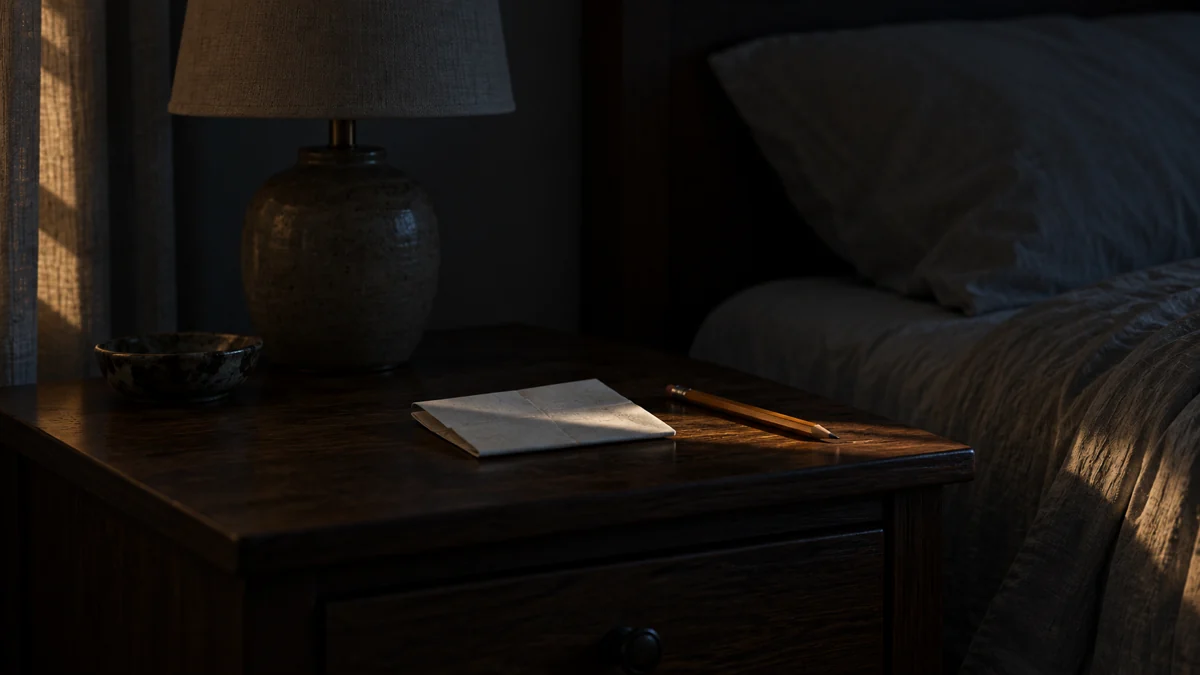
The habit follows from that. I call it, for want of a better name, leaving it at the door. When the thought comes, you do not argue with it and you do not solve it. You tell it, in so many words, that you have heard it and that it will be dealt with in daylight. Some people find it helps to write the thought down, one line, on paper kept by the bed, with no attempt at an answer. The paper is the door. What is on it is waiting outside, and it will still be there at seven.
Then comes the hard part, which is that the thought will knock again, often within a minute. The habit is not to be surprised by this, and not to take it as proof that the door does not work. You repeat the same thing: heard, noted, morning. Not sternly. The tone matters more than the words. You are not a guard; you are someone who has already locked up and is going to bed.
Some people who try this say that the first few nights the knocking is frequent, and that over a couple of weeks it thins out, not because the problems have gone but because the mind has learnt that night is not when they get handled. I cannot promise that for you. I can say it costs nothing to try and that nothing is lost if it does not take.
One more thing, since I am being plain. If you write the thought down at night, read it in the morning. Honour the arrangement. A door that is never opened in daylight stops being a door and becomes a wall, and the mind, which is not stupid, will go back to knocking at night. A few minutes with the line on the paper, over coffee, is usually all it needs: either it gets a next step, or it gets crossed out as night-sized, which a good many of them turn out to be.
And the usual honesty. If the nights are long, if this has gone on for weeks, if the days are starting to be shaped by it, then the right thing is not a letter but a conversation with someone qualified where you live. Letters are for the ordinary version of this, which is most of it.
With regards from the fifth floor,the practice
Next in the pile: A Letter on Hurry, and What It Costs